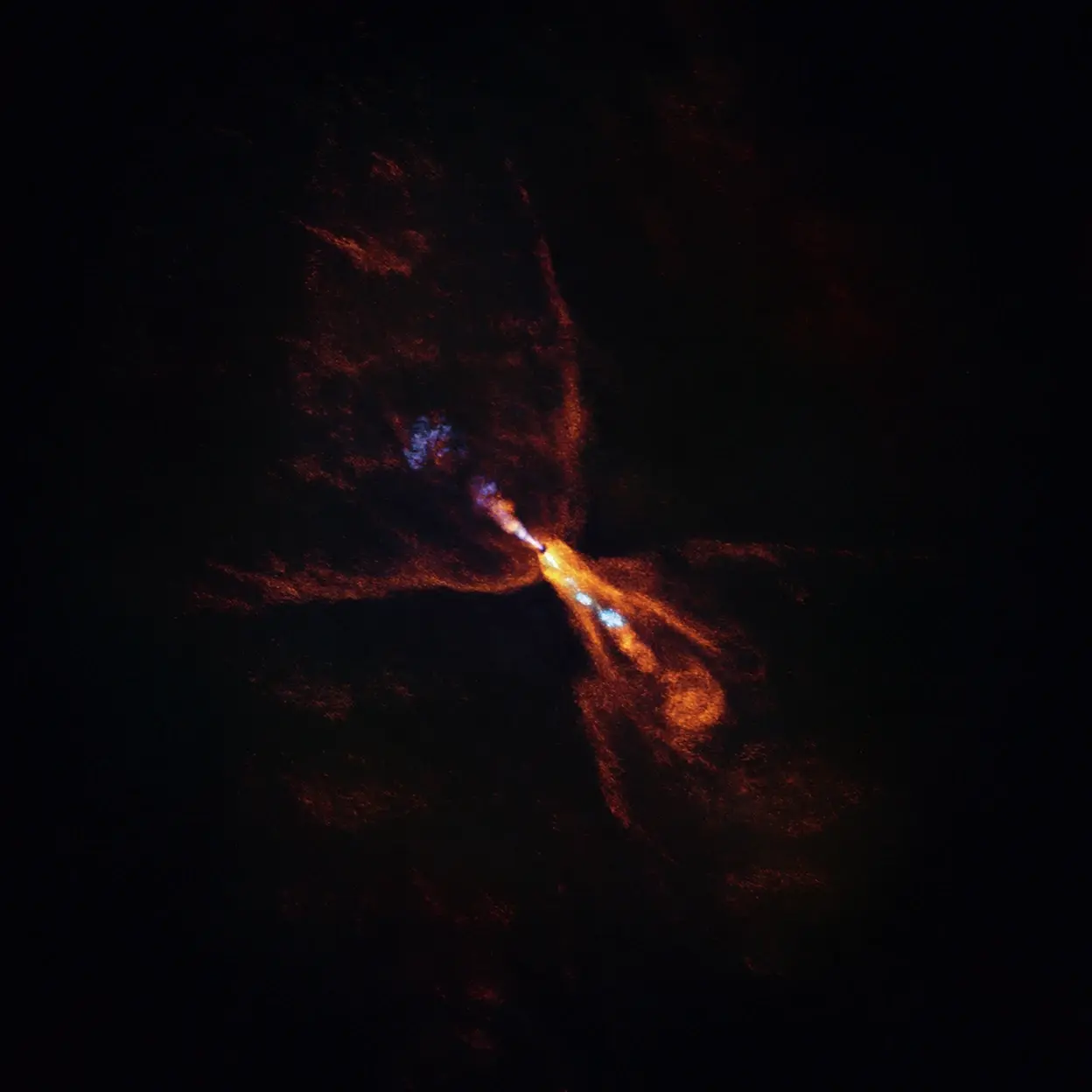
HOPS-315, as imaged by the Atacama Large Millimeter-submillimeter Array in Chile (orange is carbon monoxide blowing away from the central star, blue is silicon monoxide). Credit: ALMA(ESO/NAOJ/NRAO)/M. McClure et al. Astronomers have for the first time spotted a solar system beyond our own in its very earliest stages of formation. The research community has long sought such a system to help us understand the humble beginnings of our own. Using both ground- and space-based telescopes, the team zeroed in on the young star HOPS-315, 420 parsecs from Earth, at the start of a most exciting time: its planet-forming era. 'What we've been trying to do is find a baby version of our Solar System somewhere else,' says Merel van't Hoff, an astronomer at Purdue University in West Lafayette, Indiana, and a co-author of the study. The team originally focused its attention on HOPS-315 after detecting crystalline silicate minerals around it ' a tell-tale sign of early planet formation. (Planets form...
learn more